


MalodyV
Mugzone
I approached MalodyV as a music game for a shared phone rather than as a private, long-session hobby. That changed what I paid attention to: how quickly another person can understand the controls, whether a short turn feels worthwhile, and how easy it is to keep personal preferences separate from someone else’s. Developed by Mugzone, the game presents itself as the next generation of Malody, but its real appeal is more practical: it gives rhythm-game fans a focused place to test timing, listen closely, and improve through repetition.
It is free to install, rated for Everyone, and works on Android devices running version 6.0 or later. There are optional in-app purchases priced from $0.99 to $2.99 per item. That combination makes it approachable for a household or a group of friends who want to try it without committing money immediately, although the experience still depends heavily on whether each player enjoys demanding, accuracy-based gameplay.
How MalodyV Fits Into a Shared Device
My first useful test for a shared game is whether a person can pick it up without needing a long explanation. MalodyV does reasonably well in that respect because the basic idea is immediately understandable: music plays, visual prompts arrive in time with the track, and the player responds as accurately as possible. A rhythm-game regular will recognize the pattern quickly, while a newcomer can learn by watching one short attempt.
That does not mean every turn feels equally welcoming. Rhythm games often expose the difference between “I understand what to do” and “I can do it accurately.” Someone who has played similar music games may settle in almost immediately, while a casual player may need several attempts before the screen stops feeling busy. On a shared phone, I would introduce it with a short, comfortable session instead of handing it over during a rushed moment and judging the whole game from one difficult song.
A realistic household scenario would be two people waiting for an appointment or sharing a tablet during a quiet evening. One person plays a track, the other watches the timing and suggests trying again with a different approach. That works better than treating the game like a party title with constant conversation, because concentration matters. The most enjoyable shared use is usually taking turns, comparing progress, and discussing which patterns felt difficult rather than trying to play over one another.
Related News






The game is also suitable for a quick personal practice session. I can imagine opening it for a few attempts while waiting for transport, then stopping without needing to build a long story campaign. That compact structure is helpful for shared devices because it reduces the chance that one person occupies the phone for an entire evening. The trade-off is that players who want a broad adventure, character collection, or relaxed background game may find the focused rhythm format too narrow.
What the first session feels like
The opening experience is less about exploration and more about learning the relationship between sound, movement, and response. I recommend beginning with a track that feels readable rather than choosing the most impressive or complicated option. In a rhythm game, a song that is too demanding can make the controls seem worse than they are. A calmer first choice lets the player discover whether the timing feels natural on the particular screen.
For a shared device, I would also let each person complete a full attempt before offering advice. It is tempting to point out every missed input, but that can make a new player feel watched instead of helped. A better approach is to ask whether the problem was speed, visual overload, or simply unfamiliarity with the input style. That small distinction matters because the solution changes: one player may need an easier chart, another may need practice with the timing, and someone else may simply prefer a different kind of music game.
Gallery
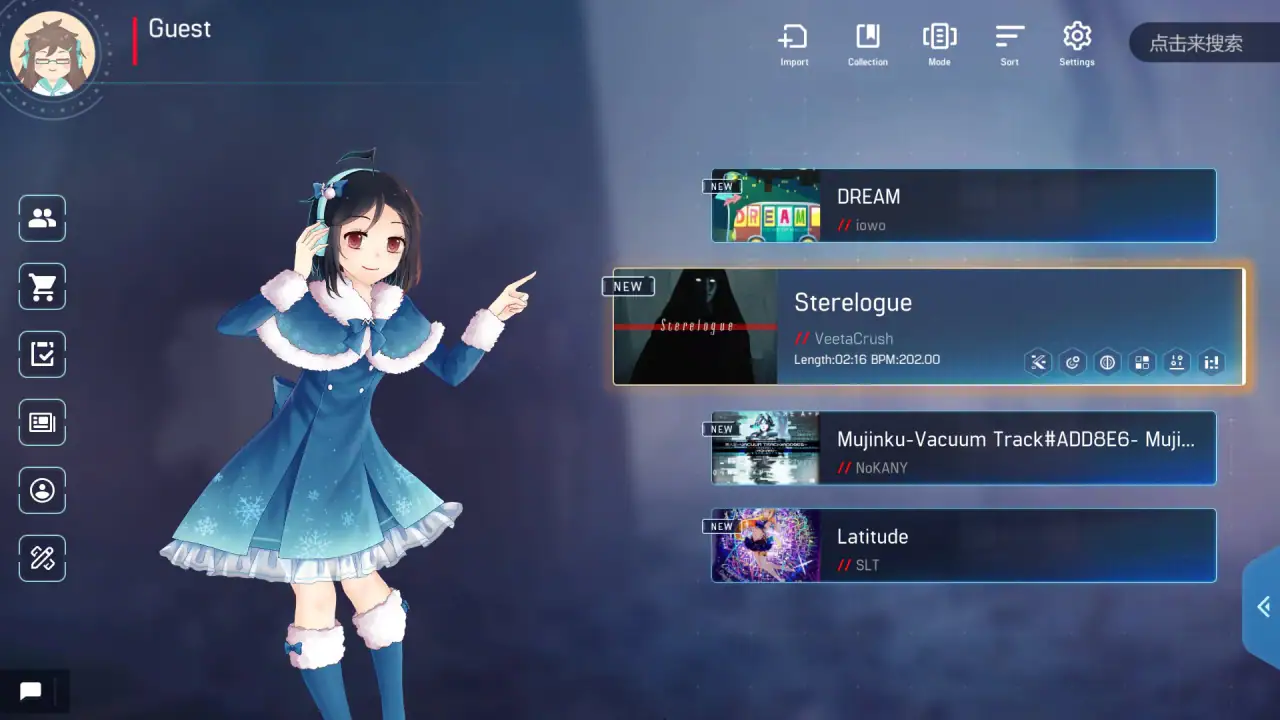
The most important household rule is simple: treat early attempts as calibration, not competition. A score comparison can be fun once everyone understands the game, but it is a poor introduction for a younger or less experienced player. MalodyV rewards attention and repetition, so a first result says more about familiarity than natural ability.
Keeping turns comfortable without inventing account features
Because I would not assume that a shared device automatically provides separate profiles or household controls, I would establish boundaries outside the game. Decide who is using the device, how long a session should last, and whether purchases require the device owner’s permission. This is especially sensible when the game is free to start but includes optional items.
That arrangement is not a criticism of the game; it is simply good shared-device practice. A child, sibling, or guest may interpret an available purchase differently from the owner. I would make the rule clear before the first session: free play is open to everyone, while any paid item requires the owner to approve it. Keeping that conversation separate from the excitement of a new song avoids awkward surprises later.
It is also worth agreeing on audio etiquette. Rhythm games are much easier to understand with sound, but a shared room may not always suit loud music. Headphones can make a session more private, though comfort and volume still matter, particularly for younger players. If headphones are unavailable, short turns at a sensible volume are more considerate than assuming everyone nearby wants to hear repeated attempts.
Coordination between different skill levels
The biggest coordination challenge is the gap between a practiced player and a beginner. The experienced person may want faster, denser patterns, while the newcomer is still learning where to look. I found that the fairest arrangement is not to force both people into the same difficulty. Let each player choose a level that creates a genuine challenge without turning every miss into frustration.
Another useful method is “explain one thing, then play.” Instead of giving a long tutorial, the experienced player can identify one practical focus, such as watching the next group of prompts or keeping a steady rhythm. After the attempt, the player can decide whether that advice helped. This keeps coaching collaborative and prevents the game from becoming a test administered by the strongest person in the room.
For siblings or friends, alternating song choice can prevent one player from controlling the entire session. One person chooses a comfortable track, the other chooses the next, and both get a chance to retry once. That creates a clearer boundary than endlessly passing the phone after every mistake. It also makes improvement visible: a second attempt can show whether the player understood the pattern better, even if the final result is not perfect.
MalodyV is not the best choice if the household wants a game built around simultaneous cooperation, conversation, or shared-screen spectacle. Its central pleasure comes from individual concentration. The shared element is mainly social comparison, coaching, and turn-taking. Families expecting a simple multiplayer party experience should look toward a game designed for that purpose instead.
Age context and trust
The Everyone rating makes the game broadly approachable from an age-classification perspective, but that does not mean every household should leave a young player entirely unsupervised with a device. The relevant questions are more ordinary: who owns the phone, who can approve purchases, whether headphones are being used responsibly, and how long a session should last.
I would be comfortable introducing it to a child who already enjoys music and can follow a clear turn-taking rule. I would be more cautious with a child who becomes upset by repeated failure, because accuracy games can feel unforgiving even when the content itself is suitable for a general audience. In that case, the adult’s role is not to demand a better score but to help the child stop at a satisfying point.
The game can also work well for an older relative or a casual player who likes testing coordination. However, the visual timing demands may be tiring for someone who prefers slower, less reactive games. A short trial is more informative than assuming the Everyone label guarantees universal enjoyment. Age suitability and play-style suitability are different things.
Trust also includes being honest about optional spending. Since the game is free and contains individual purchases between $0.99 and $2.99, I would explain that installing it does not mean every part of the experience should be bought. On a family device, the owner should handle purchasing decisions, and younger players should know that asking is part of the process rather than an interruption.
Performance expectations and practical setup
MalodyV supports Android 6.0 and newer, which covers a wide range of devices. Still, compatibility on paper does not guarantee that every phone will feel equally comfortable for precise rhythm play. Screen size, touch response, speaker quality, and general device condition can all affect how confident a player feels. Before blaming the game for missed inputs, I would test whether the phone responds consistently in other touch-based games and whether the display is easy to read.
A shared tablet can make prompts easier to see, but it may be less convenient to hold during a fast session. A smaller phone is easier to pass around, yet cramped controls can be more demanding. This is one of the less obvious trade-offs: the largest screen is not automatically the best shared option if it makes the device awkward to position. I would place the device on a stable surface when possible and let the player choose a comfortable viewing angle.
Notifications are another practical distraction. If someone is trying to improve timing, incoming messages or calls can break concentration and make a short attempt feel unfair. I would use the device’s ordinary notification settings during practice, then restore them afterward. That is not a special function of the game, but it is a simple way to make the experience more consistent on a household phone.
Storage and network expectations should also be considered before a family relies on it as an offline pastime. I would install and open the game while connected, check how the chosen content behaves, and avoid promising a younger player that every future session will work identically without preparation. The safest household approach is to test the exact device and connection first, then set expectations based on that real trial.
How it compares with familiar music-game alternatives
Compared with a casual music app, MalodyV asks for active participation rather than passive listening. You are not simply choosing a playlist and letting songs run; you are trying to match the visual and musical timing. That makes it more satisfying for someone who wants a skill to practice, but less suitable for relaxing with minimal attention.
Compared with a simple tap-to-the-beat game, it feels better suited to players who enjoy refining technique. The appeal is not only the first successful attempt; it is noticing where timing breaks down and trying to correct it. That can give the game more staying power than a novelty rhythm title, although it also means the learning curve is more visible.
Compared with a large social or competitive game, MalodyV is easier to fit into a quiet household routine. There is less pressure to coordinate a whole group at the same moment, and a player can practice alone. On the other hand, it may not provide the social energy that keeps a family engaged when everyone wants to participate simultaneously. The right comparison depends on the desired use: focused music practice favors this game, while a noisy group session favors a purpose-built party alternative.
The store shows an average rating of 3.3 from around 786 ratings, with about 41 written reviews. I read that as a sign to keep expectations measured rather than as a reason to dismiss it. Rhythm games are unusually sensitive to personal preference, device feel, and tolerance for repetition. A player who loves timing challenges may find more value than someone who wants immediate, effortless entertainment.
Who should install it, and who should skip it
I would recommend MalodyV to someone who already likes music games and wants a focused place to practice timing. It is also worth trying for a household that shares one Android device and can agree on short turns, purchase boundaries, and respectful coaching. The free entry point makes that trial straightforward, while the Everyone rating makes it easier to consider for mixed-age use.
I would skip it for a player seeking a story-driven game, a relaxed music player, or a guaranteed cooperative experience. I would also hesitate to recommend it as a first choice for someone who dislikes repeating the same challenge to improve a result. The game’s strengths are tied directly to that repetition, so the same quality can feel like a weakness when the player wants variety without practice.
My most useful tip is to judge the game after several different kinds of attempts, not one frustrating song. Try a comfortable chart, adjust the device position, use sound in a considerate way, and let the player identify the source of difficulty. If the experience becomes more readable after those changes, the game may be a good fit. If every session still feels tense or confusing, another music title with a gentler learning curve will probably serve the household better.
My household verdict
After looking at it through the lens of shared use, I see MalodyV as a specialized but worthwhile free music game. Its strongest household role is not as a universal family activity; it is as a turn-based challenge that two or more people can discuss, coach, and revisit. The experience works best when everyone accepts that players will have different skill levels and that improvement matters more than winning the first round.
Mugzone’s game has enough focus to reward dedicated rhythm fans, yet its free availability makes experimentation low-risk. The current version is 6.7.22, and the game has reached over 100 thousand installs, so it is not an obscure one-off experiment. Even so, the moderate rating suggests approaching it with realistic expectations rather than assuming the “next generation” label will make it perfect for every player.
My final recommendation is conditional but positive: install it if your household enjoys music, precise touch challenges, and taking turns with clear boundaries. Keep purchases owner-approved, choose comfortable sessions for beginners, and do not confuse an age rating with a promise that every child will enjoy the difficulty. For a focused rhythm experience on a compatible Android device, MalodyV is worth trying. For effortless family play, a gentler or more overtly cooperative alternative is likely the better choice.
FAQs for MalodyV
What is MalodyV?
MalodyV is a rhythm game focused on challenging players with music-based note patterns. It is designed for people who enjoy timing, precision, and replayable gameplay rather than a traditional story campaign. Depending on the supported mode and available content, you may encounter different play styles, customizable charts, online features, and community-created songs. Its appeal comes from practicing difficult tracks and improving your accuracy over time.
Which game modes are available in MalodyV?
MalodyV is known for offering several rhythm-game formats instead of limiting players to a single note style. Available modes may include keyboard-like lanes, falling notes, piano-oriented patterns, catch-style gameplay, and other variations, depending on the current version and platform. Each mode requires a different technique, so beginners should try the easier charts first and adjust the speed, layout, and input settings before attempting advanced levels.
Can I play custom songs or community-created charts in MalodyV?
Community content is one of the most important reasons many rhythm-game fans choose MalodyV. The game supports user-created charts and may provide tools or online features for discovering, downloading, editing, and sharing additional content. However, song availability can depend on the community, licensing, account features, and platform restrictions. Before downloading charts, check their difficulty, file requirements, and whether the content is compatible with your installed version.
Does MalodyV require an internet connection?
MalodyV may allow some locally stored songs and gameplay features to work without a constant connection, which is useful when traveling or playing with limited data. Nevertheless, internet access is generally important for downloading charts, synchronizing content, accessing online services, updating the game, and interacting with community features. The exact offline functionality can vary by version, so it is best to download desired content in advance and test it before relying on offline play.
Is MalodyV suitable for beginners, and does it include difficulty options?
MalodyV can be suitable for beginners, but the experience may feel demanding because rhythm games depend heavily on timing and coordination. New players should start with simple charts, use practice sessions, and gradually increase the difficulty instead of immediately selecting expert-level tracks. Settings such as note speed, key layout, input calibration, and visual preferences can make the game more comfortable. A compatible touchscreen, keyboard, or controller may also improve accuracy.
Pros
- Supports multiple rhythm-game modes
- including key
- taiko
- catch
- and touch.
- Built-in chart editor lets players create
- edit
- and share custom beatmaps.
- Online rankings and multiplayer features add competitive replay value.
- Highly customizable skins and note styles improve visual personalization.
- Works well for players seeking challenging community-made rhythm content.
Cons
- The interface can feel complicated for newcomers to rhythm games.
- Many charts require precise timing
- making the learning curve quite steep.
- Community content quality varies
- with some beatmaps feeling poorly balanced.
- Advanced features may require time to understand and configure properly.
- Online functionality and chart discovery depend heavily on community activity.


